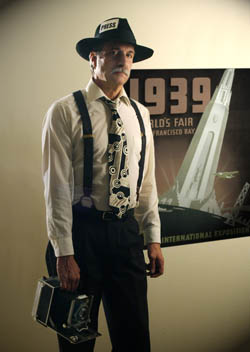
Self-portrait with 1948 Linhof Super Technika
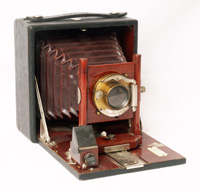
The oldest camera in my collection — a Pony
Premo from 1893. In the
Sears Roebuck catalog of that year it sold for $24.50. Built with varnished mahogany, red leather bellows, a brass
shutter and nickel-plated fittings, it has a revolving back for shooting
4x5" film in either orientation. It still works beautifully.
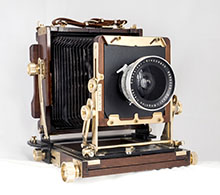
This camera looks old but isn't. It's a modern camera made by Tachihara in Japan, of 400-year-old cherry wood. It has no serial number and I can't find any documention to indicate its age, but I would guess it's no more than 15 years old. The lens on it in this picture is a 90mm Schneider Super-Angulon, which on this 4x5" view camera translates as a very wide angle.
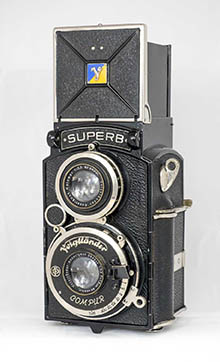 > >
This 1933 Voigtländer Superb was an unusual and incredibly sophisticated camera in its day. The film moved horizontally instead of vertically, as in every other twin lens reflex known to man, and all the controls were designed to be legible from above, the normal viewing position. For example, the speeds on the shutter ring are engraved backwards; when viewed from above, they could be read correctly in a tiny prism mounted next to the lens. In addition, the viewing lens automatically compensated for parallax by pivoting downwards simultaneously while extending forward for close focus. That's a remarkable feat of precision engineering.
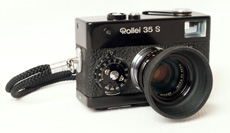
The legendary Rollei 35S, with the equally legendary Sonnar collapsible
lens. It doesn't get any sharper than that. Less than 4 inches wide, it
shoots a full 35mm frame.
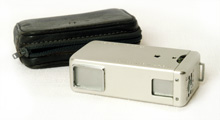
A Minolta 16. This camera is about the size of a
cigarette lighter and shoots single frames of 16mm wide film. Back in
college I used it for candid photography for the yearbook. I bought a
100-ft. roll of Tri-X movie film and reloaded the special cassettes. I
calculated that I would get about 4,000 shots from a roll.
|
|
I got into photography entirely of necessity. I had no choice. My college
major was art, but I discovered as a sophomore that I just couldn't
draw.
 But fortunately
for both my career and self-esteem, I discovered that (a) the college
yearbook needed a staff photographer, and (b) William Henry Fox Talbot,
the inventor of photography as we know it today, suffered the same unfortunate
and obvious lack of drawing skills. To make up for it, he invented what
he called “photogenic drawing,” a method of capturing a negative
image of an object on sensitized paper. But fortunately
for both my career and self-esteem, I discovered that (a) the college
yearbook needed a staff photographer, and (b) William Henry Fox Talbot,
the inventor of photography as we know it today, suffered the same unfortunate
and obvious lack of drawing skills. To make up for it, he invented what
he called “photogenic drawing,” a method of capturing a negative
image of an object on sensitized paper.
So I taught myself
basic darkroom techniques in record time and mastered the idiosyncrasies
of an ancient 4x5 Speed Graphic I found in a closet.
In the intervening
years I've explored most genres of the photographic world — journalism,
editorial, advertising, and various fine art processes, including gum
bichromate prints, photo silk screen printmaking, photo etching and polyester plate lithography.
These days I concentrate
on an annual group photography exhibit in Denver, building the wooden
pinhole cameras you've seen on this website, and shooting video and
stills for the Department of Homeland Security and Argonne National Laboratory.
My photographs have been exhibited in various venues, including the Open Shutter Gallery in Durango,
Loretto Heights College, Hal Gould's legendary Camera Obscura Gallery in
Denver, the Denver Performing Arts Center, the National Center for Atmospheric Research in Boulder, and the Chelsea National Bank in New York City.
And when there's
any time left over, I restore antique sports cars and write books.
I was born in Dearborn, Michigan;
grew up in Germany; went to high school in Switzerland; attended college
in Illinois; moved to Colorado in 1973, lived in Bavaria and England for
two periods, and then moved back to Colorado.
— Bryan Dahlberg
info@photonbox.com
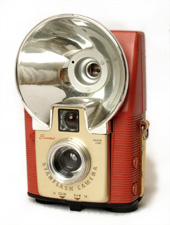 My very first camera, a 1958 Brownie Starflash.
Remembering the design trends of those years, I assume that the color
must have been called something like Caribbean Sun-Glow Coral Mistfire.
My very first camera, a 1958 Brownie Starflash.
Remembering the design trends of those years, I assume that the color
must have been called something like Caribbean Sun-Glow Coral Mistfire.
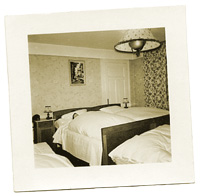
And below is my first picture with this camera. That's my 7-year-old brother, in his bed in a hotel room in Lucerne,
Switzerland.
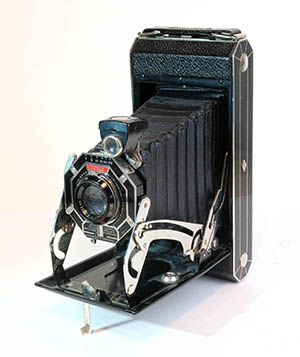
This Kodak Diodak, made sometime between 1932–36, is a beautiful example of how Art Deco design was applied to common consumer products. (It was designed by Walter Dorwin Teague, whose company still exists, having designed the interiors of every Boeing airliner since 1946.) I found it lying at the bottom of a crate of junked cameras in a local store. Amazingly, it was undamaged and shows almost no sign of ever having been used.
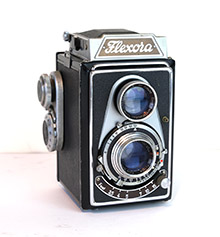
This 1951 Flexora was an entry-level twin lens reflex made by Lipca, a small company in northern Germany. The frame counter/auto transport stop on the side was an optional accessory from another company, Plaubel. The Prontor shutter has the unusual aperture range of f/3.5, 4.5, 6.3, 9, 12, 18 and 25.
|
|
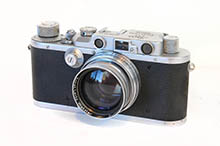
For many years I had wanted to own a Leica, and I finally knew the time had come. This is a Leica model III, made in 1936. The lens is a collapsible 50mm f/2 Leitz Summitar, made in 1952. This combination works beautifully, like a piece of fine jewelry. With my first roll of film in it, I got an image for my next book.
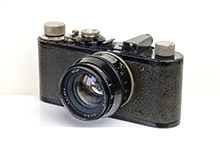
This is my Leica 1 Model C, made in early 1930, the second oldest camera in my collection. I have no intention to be a hard-core Leica collector and can't afford it anyway, but I had wanted to see how old a camera I could use for practical picture taking today. I think this is it. It works perfectly. I just wish it could talk and tell me what it has seen during the past 88 years.
It was the first model of Leica with interchangeable lenses; the lens in the picture is a Russian Jupiter-8 from the 1970s. I bought the camera from a guy in England and the lens from a guy in Moscow.
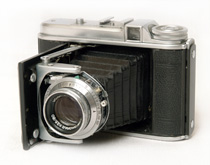
This is my 1955 Voigtlãnder Perkeo II, the camera used to take my own picture on my home page (shooting into a mirror). Despite
the fact that it shoots a medium-format 6x6 cm negative, it folds up small
enough to fit into my jacket pocket with all its vintage accessories —
a removable rangefinder, a close-up lens, a light meter the size of a
sugar cube, and an original Kodak polarizing filter (with instructions). The
Color-Skopar lens is one of the sharpest front-focusing lenses ever made.
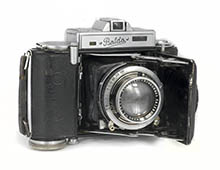
Another little folding camera, a 1940s Super Baldina from the Balda company in Dresden, Germany. This one takes 35mm film and has the top-of-the-line Schneider Xenon lens. I found it in a second-hand bookstore for $20.
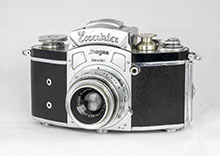
A 1933 Exakta from Germany. These
cameras were among the very first 35mm single lens reflexes, and they had interchangeable lenses. They were built like tanks, and besides their durability, they were
known for being "left-handed." The shutter release and film
advance lever were on the left side of the body. Another oddity was that
their old mechanical shutters would time an exposure up to 16 seconds.
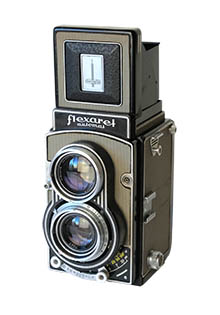 > >
Another camera that deserves to win some kind of beauty contest, a 1967 Flexaret VI, made by Meopta in Czechoslovakia. It can shoot three different formats of pictures: 6x6cm and 6x4.5cm on 120 film, as well as standard 35mm film with an adapter. It was quite popular in Europe but almost unknown in North America.
|